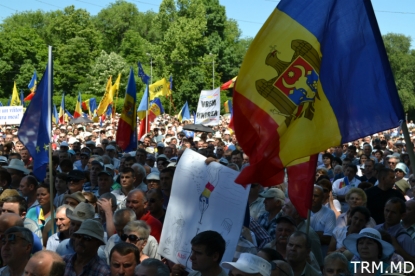
Implementation of Freedom of Assembly Policies in Moldova, January - December 2008[EN]
Implementarea Politicilor cu Privire la Libertatea de Întrunire în Republica Moldova, Ianuarie - Decembrie 2008[RO]
Внедрение политик в области свободы собраний в Республике Молдова, январь-декабрь 2008 года[RU]
Implementation of Freedom of Assembly Policies in Moldova, January - December 2008
In April 2007 the new law on public assemblies has entered into force in Moldova. The society and the decision makers seek evidence on whether and to what degree the new law has managed to addresses the existing problems with regard to the exercise of the freedom of assembly rights. Therefore, the report objective is to produce the necessary evidence that would enable us to judge on how successful the new law on assemblies has been implemented. We present a systematic account of the quantitative and qualitative evidence on the positive and successful implementation of some provisions of the new law and also the evidence on what norms of the new law are still not implemented adequately. The report contains information necessary to understand the concerns and problems remaining in the implementation of the new law.
The report has been elaborated on the basis of the 7-month long project on monitoring assemblies carried out by the Resource Center for Human Rights (CReDO) with the support of the OSCE Mission in Moldova over the period of time July - December 2008. This project continues the previous 9-month project supported by OSCE/ODIHR, involving the monitoring of the period January-June 2008[1]. The project has produced more than 350 individual observations of assemblies covering the entire territory of Moldova.
The findings firmly establish that the new law on assemblies has improved the exercise of the freedom of assembly in Moldova. The law created important benefits to the society: organizers, citizens, and the society at large. Peaceful exercise of the freedom of assembly by citizens has increased. Cases of violence remained at the level of the old law and even relatively decreased. The new law has generally been well received by organizers, while local authorities, the society at large, and the police face a few difficulties in its application.
Concerns still remain. The enforcement of the assembly rights by the police has been identified as presenting problems. The new tendency of the police to wear civilian clothes while policing assemblies rather than uniforms, as it was under the old law and in the first 4 months of the new law, is worrisome. Police presence at assemblies decreased specifically when needed, in the cases of counterdemonstrations or violent interventions from the third parties, resulting into police failing to exercise its positive obligation to protect the assembly. The prosecution of the freedom of assembly perpetrators still poses problems.
A number of recommendations have been proposed to further improve the exercise of freedom of assembly. They include: consolidation of police capacity to manage and facilitate assembles; reassessment of the practice of police presence in civilian clothes at assemblies; consolidation of the capacity of local authorities and the police to deal with the notifications procedure; development of skills among members of the commission on assemblies to work with organizers; prosecutors to proceed firmly with prosecution of perpetrators of the freedom of assembly rights; education of organizers (even in cases of several organizers) to interact with the police.
We reaffirm the earlier recommendations that have not been addressed properly: promotion of greater police awareness on a more coherent application of administrative sanctions according to the law on assemblies; consolidation of police skills in managing parallel and at times contradictory behavior of various manifestations; and exploration of opportunities for institutional improvements. The monitoring of assemblies needs to continue, especially during the period prior to and during elections. The project has already generated good evidence on the application of the new law, which shows that public authorities increase learning in the use and respect of assembly rights.
Mass Media
imagine: trm.md